Showing posts with label Gardening. Show all posts

Feb 20, 2012

If heaven were a place on Earth...

...it would be the Four Season Farm in Harborside, Maine. This place has captivated me over the past three days since I read about it in this month's issue of Martha Stewart Living magazine. The article includes the most gorgeous photographs of a lush organic home garden, including perennials, annuals, edibles and orchard fruit, hedged by forest and dotted with chickens. The home on the property is equally organic, and echoes the natural setting of the homestead. Guys, this is where I want to live when I grow up.

I wish I could scan and post the photos from the feature, but alas, copyright laws prevent it. Do yourself a favor and get the magazine. I can't find the exact photos online, so here is a taste to give you an idea...


There's so much more...a stonewall-lined edible garden, the chickens running around, the most quaint sun-warmed green house ever. It's incredible and it's exactly the style of garden I adore.

How's that for a little Monday escape?

(all photos from www.fourseasonsfarm.com)

Feb 13, 2012

3 Steps to Garden Prep

After a weekend of snow flurries and frigid temperatures, I'm talking gardens. Nothing like keeping you looking ahead, right?

Today, I want to outline my '3 Steps to Garden Prep'. These are a couple of things you can do (and I'm about to do) before the temperatures rise and soils thaw.

1. Check your USDA Planting Zone: I'm a 6b! What are you?

http://planthardiness.ars.usda.gov/PHZMWeb/
The USDA Plant Hardiness Zone Map breaks the US into 'zones' based on average minimum winter temperatures. Enter your zip code on this website to find out yours. Why does this matter? Because many plants can only survive the winter down to certain temperatures. That is, even though a plant may survive a New England frost, it may not be able to live through an Alaskan winter! Most plant catalogs and nursery plants are labeled as to which zones they are hardy within, letting you know the coldest and warmest climates a species can live year round. This is especially important for expensive species you want to keep going, such as large bushes and trees, but can also be important for edibles that need certain temperature ranges to induce the growth cycle (like artichoke and garlic, for instance). So, find your zone and commit it to memory. It will come in handy!

2. Sun map!: Find your inner cartographer

http://www.thegardencontinuum.com

Plants need sun, everyone knows that, but do you know where the sun is in your garden? Now, if you have a wide open space to plant your goodies, you can disregard this step and consider me jealous of you. If you're like me and have a maze of deciduous trees, shrubs and neighbor's houses blocking parts of your garden from the sun at any given part of the day, you're gonna want to map out which patches get full sun, partial shade, part sun, and shade (and when, i.e. afternoon/morning). What you map out isn't going to be a steadfast rule for your plants (I, for instance, have little to no full sun areas of the garden, but still manage to get some production from full sun plants such as cucumbers and other veggies), but it will help in your plan to figure out what should go where. I have made a sun map for my garden in the past, but with the snowstorm in October breaking trees like toothpicks around here (and hopefully clearing the way for more sun on my patch! Hello, silver lining!), I need to make an updated version. This website gives a great tutorial.

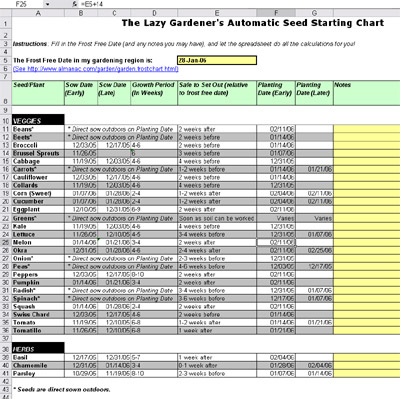
3. Seed Starting Calendar: You gotta plan for those good times!

http://www.yougrowgirl.com/2006/03/31/the-lazy-gardeners-seed-starting-chart/

Making a seed starting calendar is integral for those of us wanting to start long-growing-season-annuals (like hot peppers!) from seed even though we live in an area with a short growing season. It is also helpful in planning earlier harvests (starting tomatoes indoors will give you fruit much earlier than if you plant the seed right in the ground when the soil is warm enough outdoors). The seed starting calendar uses your region's average last frost date (the last day temperatures usually drop to freezing at the end of the winter/spring) to calculate the day you should sow the seed and the day you should plant outdoors. I know I'm explaining this poorly, but download the excel file here and you'll get what I mean. They also have a .pdf that explains the math, if you want to calculate the dates for a plant not listed on the chart. To find your last frost date, go here and use the closest city to you. (My last frost date is around May 9th, less than 3 months away!) Plug in your frost date on the excel sheet and viola! You'll have sowing and transplanting dates. Then you can start counting down the days until it's time to turn on those grow lights (not that I do that or anything).

So there ya go, a few tidbits to tide you over until it's time to get some dirt under our nails. What are you doing to prepare for the gardening season?

Jan 26, 2012

What does your garden grow?

It's only January, and already I'm thinking of gardening. I've been working lots of hours in my windowless office lately, and, well, Mama thinks it's time for some vitamin D on her skin and dirt under her nails. It's not so much that I want winter to be over (I could definitely use another cozy snow storm), but the need to get my hands in the soil is starting to nag at me, just as it usually does this time of year. This is why I love the seasons, just as I get tired of one, another totally different and equally exciting one comes along with its wonderful smells, lighting, and weather.

Back to gardening. I love it. I'm the kind of girl that plans for last frost and starts seeds accordingly. I'm the kind of girl with grow lights and heat mats. I'm the kind of girl that maps sun movement. There was a quote in the back of an issue of Mother Earth News once, "Gardening is a journey, not a destination" and boy, it couldn't be more true. I am on the gardening train. Choo! Choo! (Sorry, had to!) Here is the first garden Mike and I put in the ground together. It was at his parent's house on Cape Cod where we lived one summer. Who are those children??


And here is the raised bed at Folksy Home in all it's height-of-summer glory:


So because gardening is something I love,  and because I happen to know the difference between a brassica and a cucurbit,  we're gonna be seeing some gardening posts on this little blog. I have a raised bed in the yard (see pic above :) ), and containers scattered around outside, but today, I'm going to introduce you to my winter friends. (Mike actually calls it, 'playing with my friends' when I go out to garden in the summer. He's a funny guy, that husband of mine.) These are the indoor plants that keep my gardening bug sated through all the weather winter brings.

I don't have tons of indoor plants, mostly because I don't have the space. (What I wouldn't do to have a greenhouse!) Surprisingly, though I kill plenty of plants during the growing season (I told you it was a journey!), I have relatively good luck with indoor plants. The trick here is, basically, DO NOT WATER. I mean it. Some of my plants have not been watered since bringing them inside in early October. Seriously. And they're still doing fine.

OK, so here is my oldest and dearest indoor plant.


This is an avocado that happened to sprout in our worm composter back at our apartment in New England. Yep, this guy has been going since 2009! I've transplanted it to a few larger pots and it's still going. I know that it will never produce fruit, but it's fun to keep around. Mike has said of this plant, "I would be devastated if the avocado ever died." Yeah, so I'm desperately trying not to kill it. My basic plan for this guy is water when it looks droopy. During the winter, that's like a pint glass every week or so.


This guy is a money tree. Both this and the avocado live in the kitchen in the winter because that's where it's sunniest. He chills with even less watering than the avocado, maybe a pint glass every two weeks? I try to keep them as dormant as possible so they don't fight to grow in adverse conditions (i.e. a cold an dry kitchen). Funny story about this plant, which I've had since 2007: my cat once ate every single leaf off of this plant except 4. 4! And it came back. And now it's about 3x as big as it was back then. Money tree for the win.

To the right of the money tree is a peace lily given to me by my sister-in-law when she was moving. He got hit with quite the slug problem this summer, and is still fighting to come back. Even less watering for him than the above two. Though after seeing this photo I brought that drooper into the sink for a little drink.

Moving out of the kitchen, and into the bedroom, I have a jade plant on the rope shelves. No water since October!


And a pothos cutting keeping fishy company. (Obviously no need for water. Or soil, for that matter!)


The last little grouping of plants is a stash of succulents that live in the bathroom on the seedling shelf.


I started with a few individual plants (bought at the Philly Flower Show, whoop whoop!!) and then found out propagation was beyond simple and began experimenting last summer. I haven't really attended to them much because, well, winter isn't an ideal time to start new plants, but they're still goin'!


Hopefully when it warms up they'll spring back to life. We'll have to wait and see! No water for these guys, I think they get enough from the shower moisture to tide them over.

So there is the starting line of the indoor brigade. I do have some poinsettias and a few paperwhite bulbs going,


but they're ephemeral and don't last season to season.

What kind of plants do you have inside for the winter?